
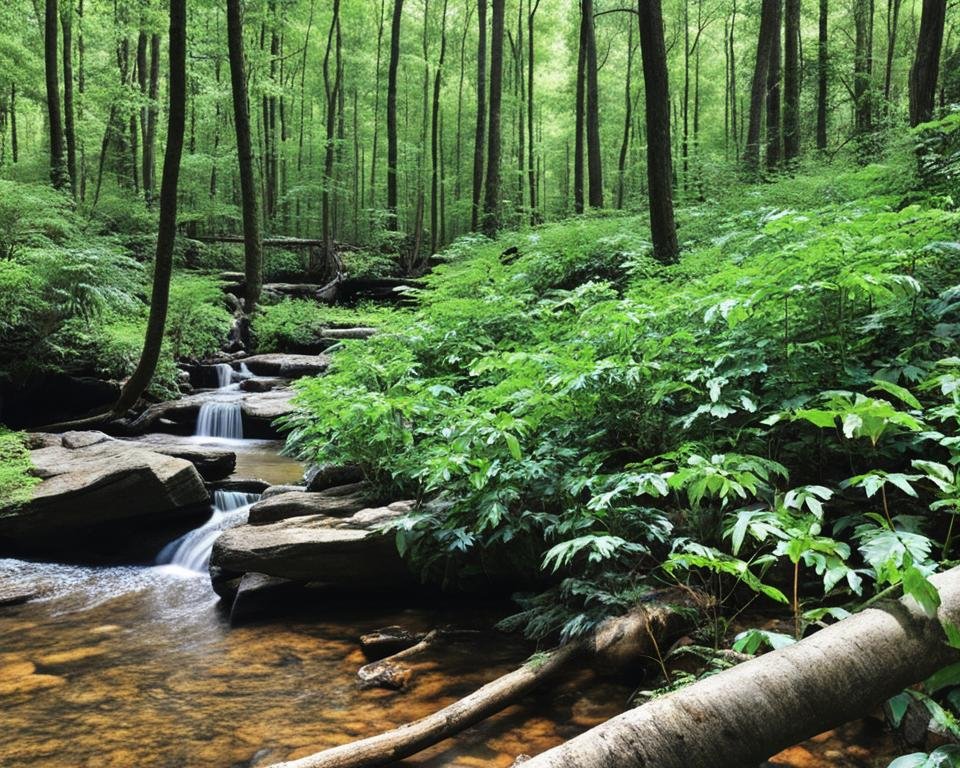
Montgomery Bell State Park protects more than a place to hike, fish, or stay overnight. Within the park, the Montgomery Bell State Natural Area preserves high-quality forest communities that help tell the ecological story of Tennessee’s Western Highland Rim.
The Montgomery Bell State Natural Area
The Tennessee Division of Natural Areas describes two protected tracts within the larger state park. Together they represent important oak-hickory forest communities, including drier ridge forests and more moisture-rich areas with large trees. The natural area was designated in 1998 and is managed as a Class II Natural-Scientific State Natural Area.
That distinction matters. The park is used for recreation, but parts of its landscape are also protected because of their scientific and conservation value. Visitors can help by remaining on established trails, leaving plants and natural objects in place, and avoiding activities that disturb wildlife or damage habitat.
Forests shaped by land use and recovery
The surrounding region has a long history of timber use and iron production. State information notes that iron furnaces once depended on the area’s forests for fuel and that the last recorded logging in the park occurred before the land came under public ownership. Today, the protected tracts allow visitors to see representative Western Highland Rim forest communities and understand how conservation and public recreation can share a landscape.
Conservation is active work
Protecting a park is not simply a matter of drawing a boundary. Tennessee’s current park-management planning addresses native plants, environmental awareness, cultural resources, forest and grassland restoration, natural-area monitoring, and improved interpretation of historic sites. Priorities and methods can change as conditions and scientific understanding change.
How visitors can reduce their impact
- Stay on maintained trails and respect closures.
- Do not collect flowers, plants, rocks, or historic objects.
- Observe animals from a distance and never feed them.
- Keep pets under control and follow posted leash rules.
- Pack out trash and food scraps.
- Clean footwear and outdoor equipment when moving between natural areas to reduce the spread of invasive species.
- Report hazards or serious resource damage to park staff rather than attempting a repair yourself.
Experience the park’s natural side
Use our wildlife and nature guide for responsible viewing ideas, the birding guide for a focused outing, and the hiking guide to choose a route. The park map and Things to Do hub can help connect these experiences into a larger visit.
Official references
Conditions, boundaries, management priorities, and access guidance should be confirmed with the agencies responsible for the land:
- Tennessee Division of Natural Areas: Montgomery Bell
- Tennessee State Parks: Montgomery Bell State Park
Frequently asked questions
Is the entire state park a designated natural area?
No. The designated natural area consists of protected tracts within the larger state park. Both are publicly managed, but their designations and purposes are not identical.
Can visitors hike in the natural area?
The state lists public access and maintained trails. Check current park information and obey closures or posted restrictions before entering.
Why avoid publishing exact locations for sensitive plants or wildlife?
Precise location information can unintentionally increase disturbance, collection, or trampling. General habitat education is often more responsible than directing traffic to a vulnerable population.
A better way to use this guide
Read conservation in the recovered landscape
The park’s forests and waters sit on land shaped by extraction, farming and settlement. Conservation here is not a story of untouched wilderness; it is a continuing relationship among recovery, recreation, habitat and responsible public use.
Visitors help by staying on durable routes, protecting wildlife, carrying waste out and treating temporary closures as conservation tools rather than inconveniences.